
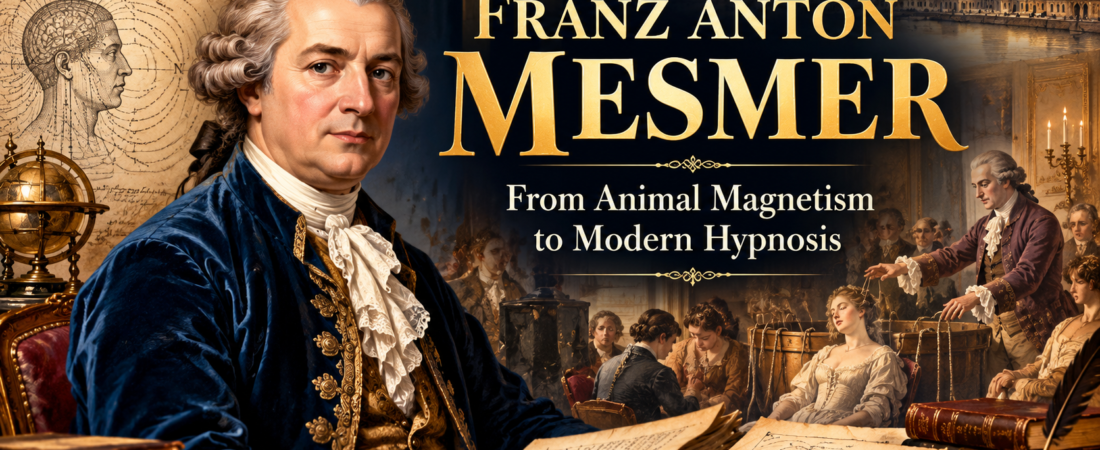
From “Animal Magnetism” to Modern Hypnosis
By Milind Sable | Milind Sable Academy
For centuries, people have been fascinated by the power of the human mind.
Can suggestion change the way we experience pain? Can focused attention alter perception? Can a person’s expectations influence how they feel?
Long before modern hypnosis became a subject of psychological research, one European physician became famous for proposing a controversial explanation for these phenomena.
His name was Franz Anton Mesmer.
Mesmer’s ideas were eventually rejected as a scientific explanation, but his story became an important chapter in the history of hypnosis and the study of suggestion.
1. Who Was Franz Anton Mesmer?
Franz Anton Mesmer (1734–1815) was an Austrian physician who became famous in the late eighteenth century for his unusual approach to healing.
Mesmer proposed that an invisible force existed in nature and that this force influenced human health. He called it “animal magnetism.”
According to Mesmer’s theory, illness could occur when this supposed magnetic force became disturbed or imbalanced.
His approach became known as Mesmerism.
It is important to understand that Mesmer did not use the modern term “hypnosis” to describe his method. The terminology and scientific understanding of hypnosis developed later.
2. What Was “Animal Magnetism”?
Mesmer initially experimented with magnets.
He believed that magnets could influence the invisible force he called animal magnetism. However, he eventually concluded that magnets themselves were unnecessary and that similar effects could be produced through his own actions and interactions with patients.
This became one of the most fascinating aspects of Mesmer’s story.
His theory was about a physical or natural force.
But the experiences reported by his patients raised another possibility:
Could expectation, attention, suggestion and belief themselves influence human experience?
That question would become extremely important in the later development of psychology and hypnosis.
3. How Did Mesmer Treat His Patients?
Mesmer’s treatment sessions were very different from modern clinical hypnosis.
In Paris, he became increasingly popular and eventually developed group treatment methods because the number of people seeking his services became very large.
Historical accounts describe patients sitting around a large container or tub of water containing metal materials. Patients could hold rods connected to the arrangement while Mesmer moved around the group and interacted with them.
Music was sometimes part of the atmosphere.
Some patients experienced dramatic reactions, including crying, fainting or convulsions.
To people of eighteenth-century Europe, these sessions could appear extraordinary.
But the crucial question remained:
What was actually causing these experiences?
4. Mesmer’s Popularity in Paris
Mesmer eventually moved to Paris, where his reputation grew rapidly.
He attracted many patients and became a well-known figure.
His popularity became so significant that the French authorities eventually became interested in investigating his claims.
This was an important moment—not only for Mesmer, but also for the history of scientific investigation.
The question was no longer simply:
“Does Mesmer’s treatment appear to work?”
The deeper question became:
“What is actually producing the effect?”
5. Benjamin Franklin and the 1784 Investigation
In 1784, King Louis XVI appointed commissions to investigate Mesmer’s claims about animal magnetism.
One of the commissions was chaired by Benjamin Franklin, who was then the American ambassador to France.
The investigation also involved prominent scientists, including Antoine Lavoisier.
The investigators attempted to determine whether the supposed magnetic force actually existed.
Their experiments were significant because they introduced a much more controlled way of examining Mesmer’s claims.
6. What Did the Commission Discover?
The commission did not find evidence supporting Mesmer’s proposed animal magnetism as a physical force.
Importantly, the investigators observed that people could experience effects even when they were unaware of whether they were actually being exposed to the supposed magnetic influence.
The APA’s historical account describes the investigators as concluding that the effects were associated with the patients’ own expectations and mental processes rather than an external magnetic force.
This did not mean that the experiences of Mesmer’s patients were necessarily imaginary in the simple sense of “nothing happened.”
Rather, it raised a much more interesting scientific question:
How can expectation, attention and suggestion influence human experience?
That question would continue long after Mesmer.
7. Was Mesmer Actually Doing Hypnosis?
This is where history needs some precision.
It would be inaccurate to simply say:
“Mesmer invented modern hypnosis.”
Mesmer’s animal magnetism and mesmerism were not the same thing as modern hypnosis.
However, Mesmer’s work occupies an important place in the historical development of ideas surrounding suggestion, altered experiences and therapeutic influence.
Later researchers and practitioners developed different explanations and techniques.
The terminology also changed.
This is why Mesmer is best understood as an important historical figure in the development of hypnosis, rather than simply the inventor of modern hypnosis.
8. From Mesmerism to Hypnosis
The story did not end with Mesmer.
During the nineteenth century, other physicians and researchers continued investigating mesmerism and related phenomena.
One particularly important figure was James Braid, a Scottish physician.
Braid moved away from Mesmer’s explanation of magnetic forces and developed his own approach.
He used the term “neuro-hypnotism”, later shortened to “hypnotism.” His work included techniques involving focused attention, including eye-fixation methods.
This represented a major conceptual shift:
From an invisible magnetic force → toward psychological and physiological explanations of hypnosis.
That transition helped shape the later history of hypnotism.
9. Mesmerism and Modern Hypnosis Are Not the Same
It is useful to distinguish three historical concepts:
Mesmerism
Associated with Mesmer’s theory of animal magnetism.
Hypnotism
A later approach that developed through nineteenth-century investigation, including the work of James Braid.
Modern Hypnosis
A field involving suggestion, focused attention and changes in perception, cognition, emotion or behavior. Modern definitions and theories continue to be studied in psychology.
Therefore, the history is not a simple straight line.
It is better understood as an evolution of ideas about:
attention → suggestion → expectation → perception → human experience.
10. Why Is Mesmer Still Important Today?
More than two centuries later, Mesmer remains an interesting historical figure because his story raises questions that are still relevant.
For example:
- How powerful is expectation?
- How does suggestion influence perception?
- Why do people respond differently to the same suggestion?
- How does focused attention affect experience?
- What role does the relationship between practitioner and client play?
- How can psychological processes influence the experience of pain and other symptoms?
Modern hypnosis research approaches these questions using very different scientific frameworks from Mesmer’s animal magnetism.
The American Psychological Association describes hypnosis as a procedure involving suggestion that can produce changes in sensation, perception, cognition, emotion or motor behavior, while noting that the exact nature of hypnotic suggestibility and its applications continue to be studied.
11. The Interesting Lesson From Mesmer’s Story
Perhaps the most fascinating lesson from Mesmer’s story is not whether his theory of animal magnetism was correct.
It wasn’t supported by the scientific investigations of his time.
The more interesting lesson is what happened after his theory was challenged.
Researchers did not simply stop asking questions.
Instead, attention gradually shifted toward understanding the mind, suggestion, expectation, attention and human experience.
In that sense, Mesmer’s story illustrates an important principle of science:
A rejected explanation can still lead to valuable questions.
The explanation may change.
The investigation continues.
12. From Mesmer to Modern Hypnotherapy
The history of hypnosis eventually moved far beyond Mesmer.
Physicians, psychologists and researchers developed new theories and techniques for understanding hypnotic phenomena.
Hypnosis also became part of psychological research and, in some contexts, clinical practice.
Modern literature discusses hypnosis in relation to areas including pain management and psychotherapy, while research continues to investigate when and for whom it is useful.
The modern field therefore cannot be reduced to Mesmer’s original theory.
But understanding Mesmer helps us understand where the journey began.
13. Mesmer’s Legacy
Franz Anton Mesmer’s greatest historical importance may not lie in his explanation of animal magnetism.
Instead, his legacy lies in the chain of questions that followed his work.
His story contributed to a fascinating historical transition:
Animal Magnetism
↓
Mesmerism
↓
Investigation of Suggestion and Expectation
↓
Braid’s Hypnotism
↓
Psychological Research on Hypnosis
↓
Modern Hypnosis and Hypnotherapy
This history demonstrates how an idea can evolve dramatically when
researchers begin testing its underlying assumptions.
Conclusion
Franz Anton Mesmer was a physician whose theory of animal magnetism eventually failed scientific investigation.
Yet his story did not disappear.
Mesmerism became part of a much larger historical development that eventually contributed to investigations of suggestion, attention and hypnosis.
James Braid and later researchers moved the field in new directions, helping separate hypnosis from the original concept of magnetic forces.
Today, hypnosis is studied using psychological and scientific frameworks very different from those of eighteenth-century mesmerism.
Understanding this history gives us a better perspective on hypnosis—not as a mysterious power invented by one person, but as a field that developed through centuries of observation, experimentation, debate and changing scientific ideas.
And that is what makes the story of Franz Anton Mesmer so fascinating.
About Milind Sable Academy
Milind Sable Academy provides training and educational resources in Hypnotherapy, Hypnosis, Self-Hypnosis, NLP, Meditation, Mental Training and AI Training.
Through its educational programs, the Academy aims to help learners understand the principles, techniques and practical applications of human potential and mental training.